

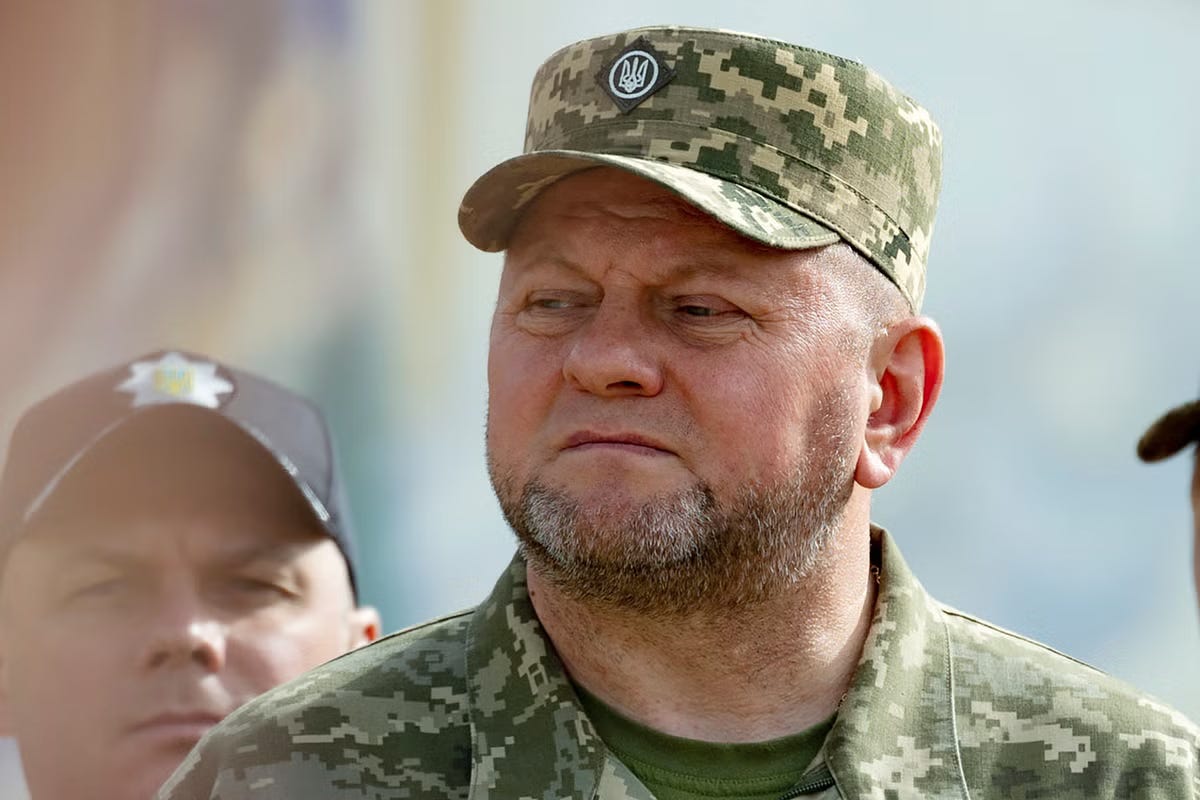
Ambassador to the UK and former Commander-in-Chief, General Zaluzhnyi, published an extensive essay in Dzerkalo Tyzhnia offering a detailed analysis of the past two years of the Russia-Ukraine war, covering the transformation of modern warfare, combat operations, the future of the conflict, and his perspective on Ukraine’s theory of victory. I have translated the most important sections—almost the entire essay—and added subtitles for improved readability.
CONTENT
The Positional Stalemate
The Role of UAVs in Modern Combat
Other Conflict Cases
Technological Adaptations
Countermeasures for Stalemate
Theory of Victory
The Positional Stalemate
I am more convinced than ever that the armed forces of both Russia and Ukraine slipped into a positional deadlock, one that strongly resembled the stalemate of the First World War.
Already by the autumn of 2022, it was on the Donetsk axis that combat gradually began to assume a positional character.
The “stupor” I described, of course, was not identical to a full-scale positional war. Despite the relative stability of the frontline, there was slow progress, sometimes localized and sometimes broader, taking on a creeping nature marked by disproportionate losses. This was less about sharp, decisive blows by maneuvering armored formations and more akin to a grinding “meat grinder.”
Such localized Russian advances were most visible in the battles for Bakhmut and Avdiivka.
Unlike classical operations aimed at annihilation, Russian forces pursued a strategy of pressure, gradually forcing our units out of entrenched positions. Yet, with the exception of Bakhmut, our forces largely retained their combat effectiveness.
Another feature of the stalemate was that the absence of rapid breakthroughs ruled out the most effective form of maneuver, encirclement. Likewise, the inability to fully suppress enemy air defenses eliminated the option of airmobile operations, long emphasized in NATO doctrines.
The decisive factor behind this impasse during our 2023 offensive was, above all, the classical shortage of manpower and resources within our assault groupings.
Breaking through such a fortified front required overwhelming superiority at the chosen sector, combined with mobile reserves ready to exploit the breach and push into operational depth before the enemy could counterattack or establish a new defensive line. Unfortunately, for both objective and subjective reasons, we were unable to generate such superiority by the time the offensive began.
This shortage stemmed primarily from the dispersal of prepared assault formations across other fronts, as well as the creation of ground components from ministries and agencies outside the military, units that were, to put it mildly, not fully prepared for modern combat. It was also compounded by a lack of appreciation among some commanders for the need to rotate battle-ready units and prepare them specifically for offensive operations.
Finally, the inadequate, and at times entirely absent, minimum levels of armament in newly formed units depended wholly on the vision and capabilities of our partners.
All this resulted in the lack of properly trained reserves needed for large-scale maneuver offensives and, as a consequence, led to predominantly positional fighting across all sectors of the offensive.
The enemy, for its part, relied on extensive defensive lines, multilayered and highly developed in engineering terms.
The Role of UAVs in Modern Combat
